
On this page
- 1. Positioning, specs, and rate cards
- 2. What LLMLearner production benchmarks show
- 3. Coding and agents: interactive builds vs. long-horizon CLI
- 4. Beyond the leaderboard: writing, frontend taste, and coding discipline
- 5. Four caveats worth knowing before you switch
- 6. Practical recommendation: how to route between the three
Google DeepMind’s Gemini 4 Neon (often shortened to Gemini 4 Neo in developer communities) arrived on November 18, 2026, one day after OpenAI launched GPT-6.2 Sol and two months after Anthropic’s Claude Opus 5.5. Within days, Neon became the most discussed daily-driver model across engineering forums—not because it is the heaviest model in its own family (that role belongs to Gemini 4 Carbon), but because it lands in the exact spot where intelligence, latency, and price start to feel balanced.
This comparison puts Gemini 4 Neon, Claude Opus 5.5, and GPT-6.2 Sol side by side using live production data from the LLMLearner catalog, independent cost and runtime measurements, community reports from Hacker News and Reddit, and firsthand workflow testing in Google Antigravity (AGY). Where we step beyond published benchmarks into hands-on impressions—such as writing tone, frontend taste, and coding discipline—we label those observations explicitly.
1. Positioning, specs, and rate cards
All three models target high-frequency engineering and knowledge work, yet their pricing and modality choices carve out distinct lanes.
| Dimension | Gemini 4 Neon | Claude Opus 5.5 | GPT-6.2 Sol |
|---|---|---|---|
| Provider & release | Google DeepMind · Nov 18, 2026 | Anthropic · Sep 22, 2026 | OpenAI · Nov 17, 2026 |
| Family role | Mid-tier workhorse between Hydrogen and Carbon | Flagship for long-horizon coding & agent loops | Everyday coding & scalable agent model |
| Context window | 1M tokens (unified pricing) | 1M tokens (standard pricing) | 1.05M tokens |
| Max output | 1M tokens (Long Decode) | 128K tokens | 128K tokens |
| Input modalities | Text, image, audio, video | Text, image | Text, image |
| Knowledge cutoff | 2026-03 | 2026-06 | 2026-06-01 |
| Thinking control | 4 tiers (low, medium, high default, xhigh) | Always-on adaptive thinking (default medium) | Configurable effort + Ultrafast mode |
| Standard API (per 1M) | $3.00 / $15.00 | $4.00 / $20.00 | $2.00 / $10.00 |
| Cache read (per 1M) | $0.15 (95% off; implicit cache only) | $0.20 (cache write $5 / $8) | $0.10 |
| Blended price (4:1, 90% cached) | $3.348 / 1M | $4.464 / 1M | $2.232 / 1M |
Three structural differences jump out before looking at a single benchmark:
- Clean pricing ladder: GPT-6.2 Sol ($2/$10) sits at the bottom, Gemini 4 Neon ($3/$15) in the middle, and Claude Opus 5.5 ($4/$20) at the top.
- Native full multimodality + 1M output: Neon is the only model in this trio that accepts audio and video natively and decodes up to 1M tokens in one pass.
- Cutoff lag: Neon’s March 2026 knowledge cutoff trails both Opus 5.5 and GPT-6.2 Sol by three months—a gap that shows up whenever you work with freshly updated SDKs or newly deprecated APIs.
2. What LLMLearner production benchmarks show
On comparable benchmarks in the LLMLearner production catalog (as of November 22, 2026), the head-to-head win–loss records are unambiguous:
- Gemini 4 Neon vs. Claude Opus 5.5: 14–7 (view full comparison)
- Gemini 4 Neon vs. GPT-6.2 Sol: 14–1 (view full comparison)
- Claude Opus 5.5 vs. GPT-6.2 Sol: 9–8 (view full comparison)
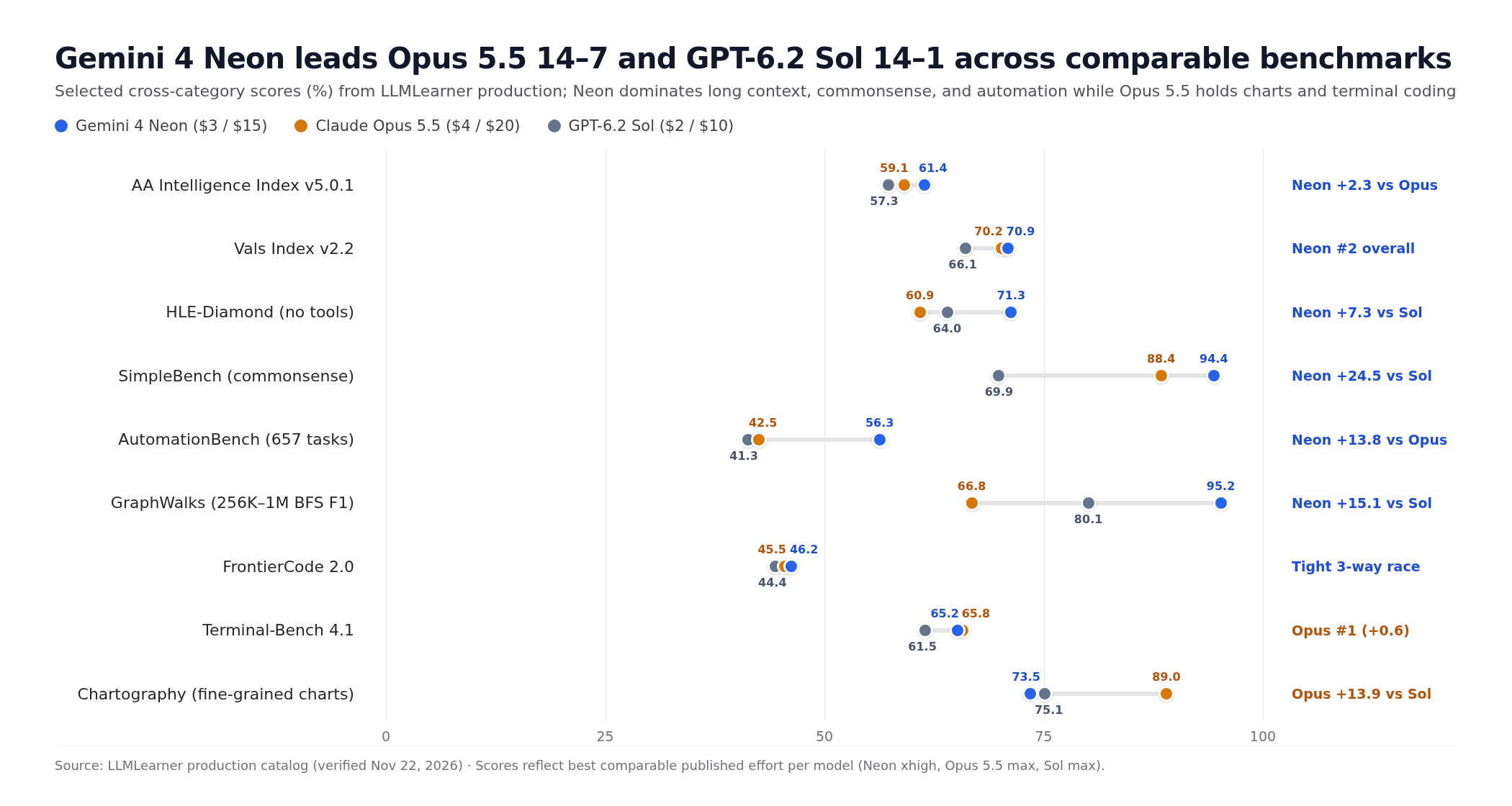
The breadth of Neon’s lead is what stands out. It ranks #3 of 62 on the Artificial Analysis Intelligence Index v5.0.1 (61.4, edging past its heavier sibling Gemini 4 Carbon at high effort), #2 of 36 on Vals Index v2.2 (70.9), #1 of 16 on AA-Omniscience (54.8) for factual discipline, and #1 of 64 on Vending-Bench 2 (16,843 vs. Opus 5.5’s 9,235) for long-horizon planning.
Three benchmark gaps deserve special attention:
- Commonsense reasoning (
SimpleBench): Neon scores 94.4 (#2/106) and Opus 5.5 hits 88.4 (#6/106), while GPT-6.2 Sol drops sharply to 69.9 (#30/106). In open-ended problem solving, that gap is easy to feel. - Long-context recall (
GraphWalks, 256K–1M BFS F1): Neon posts 95.2%, versus 80.1% for GPT-6.2 Sol and 66.8% for Opus 5.5. Having a 1M context window on paper is no longer rare; keeping accuracy intact near the ceiling still is. - Office automation & legal synthesis: Neon leads
AutomationBenchby nearly 14 points (56.3 vs. 42.5 and 41.3) and ranks #1 of 91 onLegal Research Bench(56.3 vs. Opus 5.5’s 50.5).
Yet Opus 5.5 has clear strongholds where Neon trails decisively: Chartography (89.0 #5/29 vs. Neon’s 73.5 and Sol’s 75.1), Tax Agent Bench (70.5 #6/74 vs. Neon’s 54.9), and AA-Briefcase (1800 Elo #2/20 vs. Neon’s 1700 Elo).
3. Coding and agents: interactive builds vs. long-horizon CLI
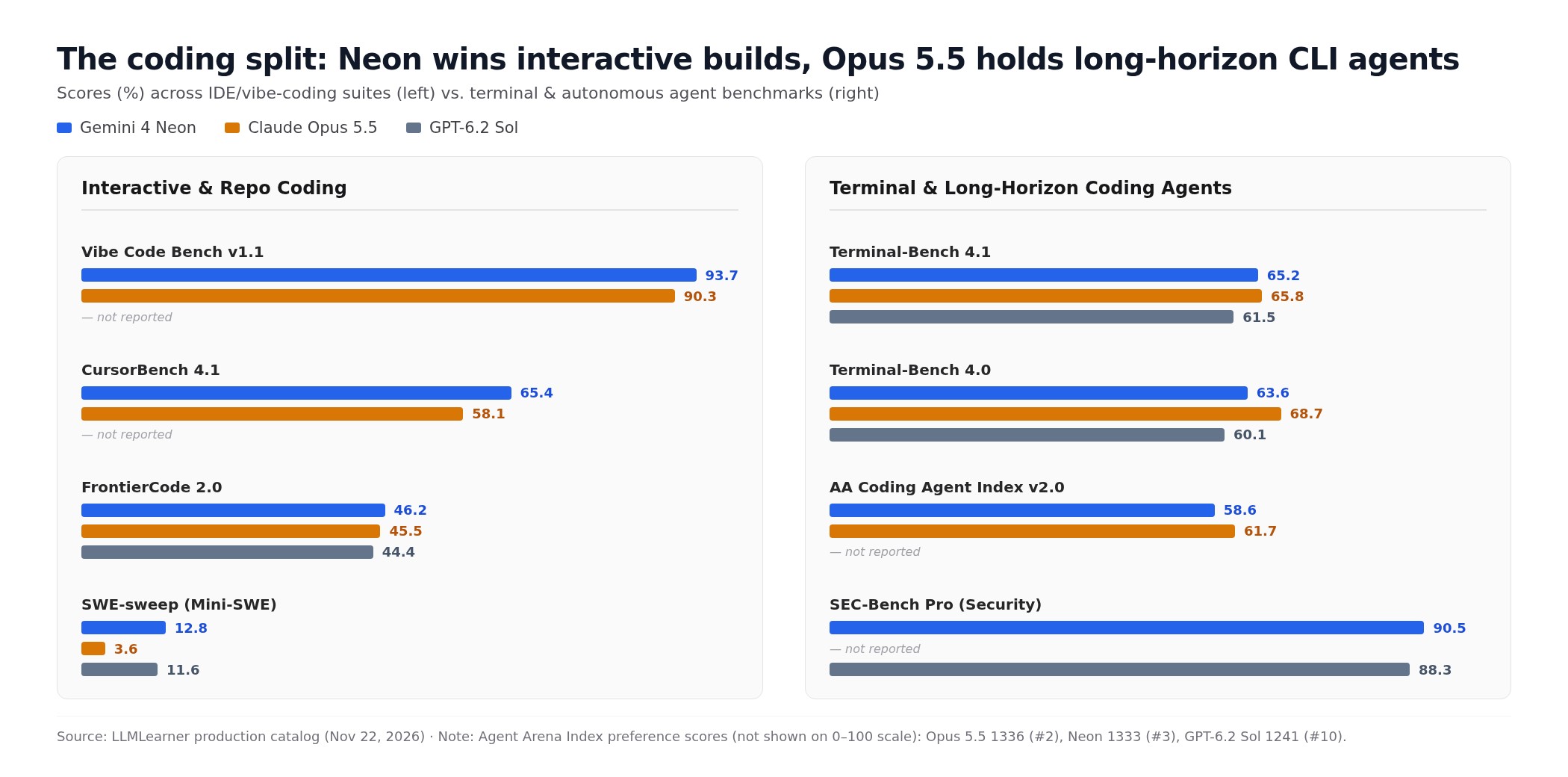
Software engineering is where the Neon vs. Opus 5.5 rivalry is closest—and where splitting the benchmarks by workflow type makes the pattern obvious.
| Benchmark | Gemini 4 Neon | Claude Opus 5.5 | GPT-6.2 Sol |
|---|---|---|---|
| Vibe Code Bench v1.1 | 93.7 (#2 / 121) | 90.3 (#7 / 121) | — |
| CursorBench 4.1 | 65.4% | 58.1% | — |
| FrontierCode 2.0 | 46.2 (#3 / 36) | 45.5 (#4 / 36) | 44.4 (#5 / 36) |
| SWE-sweep (Mini-SWE harness) | 12.8 (#2 / 20) | 3.6 (#9 / 20) | 11.6 (#3 / 20) |
| Terminal-Bench 4.1 | 65.2 (#3 / 48) | 65.8 (#1 / 48) | 61.5 (#6 / 48) |
| Terminal-Bench 4.0 | 63.6 (#7 / 90) | 68.7 (#2 / 90) | 60.1 (#10 / 90) |
| AA Coding Agent Index v2.0 | 58.6 (#5 / 10) | 61.7 (#1 / 10) | — |
| SEC-Bench Pro (vulnerability analysis) | 90.5 (#1 / 13) | — | 88.3 (#2 / 13) |
| Agent Arena Index (Elo) | 1333 (#3 / 36) | 1336 (#2 / 36) | 1241 (#10 / 36) |
In short: Neon wins interactive, multi-file IDE and app-building work (Vibe Code Bench v1.1, CursorBench 4.1, FrontierCode 2.0, SWE-sweep), while Opus 5.5 still holds the crown for unattended, long-horizon terminal agents (Terminal-Bench 4.0/4.1, AA Coding Agent Index v2.0). On blind human preference in Agent Arena Index, the two are effectively tied (1336 vs. 1333), both nearly 100 Elo ahead of GPT-6.2 Sol (1241).
4. Beyond the leaderboard: writing, frontend taste, and coding discipline
Benchmarks rarely capture how a model feels over an eight-hour workday. Combining firsthand engineering sessions in Google Antigravity (AGY) with recurring themes on Hacker News and Reddit (r/google_antigravity, r/GeminiAI) surfaces four practical differences:
- Writing without “AI voice.” Our firsthand impression—that Neon writes cleanly and feels natural in interactive back-and-forth—echoes one of the loudest takeaways on Hacker News. Developers repeatedly note that Gemini 4 Neon avoids the overly polished, formulaic “Claudese” cadence that often triggers AI-dar in technical docs, PR descriptions, and blog drafts. In independent manuscript-editing evaluations, Neon caught roughly 98% of planted errors, matching Opus 5.5 while leaving fewer awkward phrasing seams. By contrast, early feedback on GPT-6.2 Sol flags stiffer prose and occasional tone friction on everyday writing.
- Coding discipline: neither lazy nor over-testing. One of the sharpest day-to-day advantages we noticed with Neon is pacing. Older or weaker models tend to get lazy—leaving stubs or skipping edge cases—while recent GPT coding loops often swing to the opposite extreme, over-testing and over-engineering tiny edits with sprawling, brittle test scaffolding that burns time. Neon hits a pragmatic middle ground: it finishes the implementation cleanly without cutting corners and respects tight repository conventions instead of inventing ceremony. That tracks closely with its strong first-pass completion rates on
Vibe Code Bench v1.1(93.7) andCursorBench 4.1(65.4%). - Solid frontend taste. On UI components, interactive pages, and single-file web prototypes, Neon produces coherent hierarchy, spacing, and visual restraint rather than defaulting to generic gray-card templates. Opus 5.5 still competes closely on design polish, but at a higher cost and slower turn latency; GPT-6.2 Sol is sharper on backend logic and code review than on visual craft.
- Quota comfort inside Google Antigravity (AGY). In daily AGY sessions, Neon’s usage budget holds up well compared with heavier frontier tiers. It works particularly smoothly as the primary planner and editor—handling architecture, frontend work, and documentation directly while delegating repetitive lookups to lighter sub-agents such as Gemini 4 Hydrogen.
5. Four caveats worth knowing before you switch
The community enthusiasm around Gemini 4 Neon is earned, but LLMLearner’s independent analysis and developer stress tests highlight four real tradeoffs:
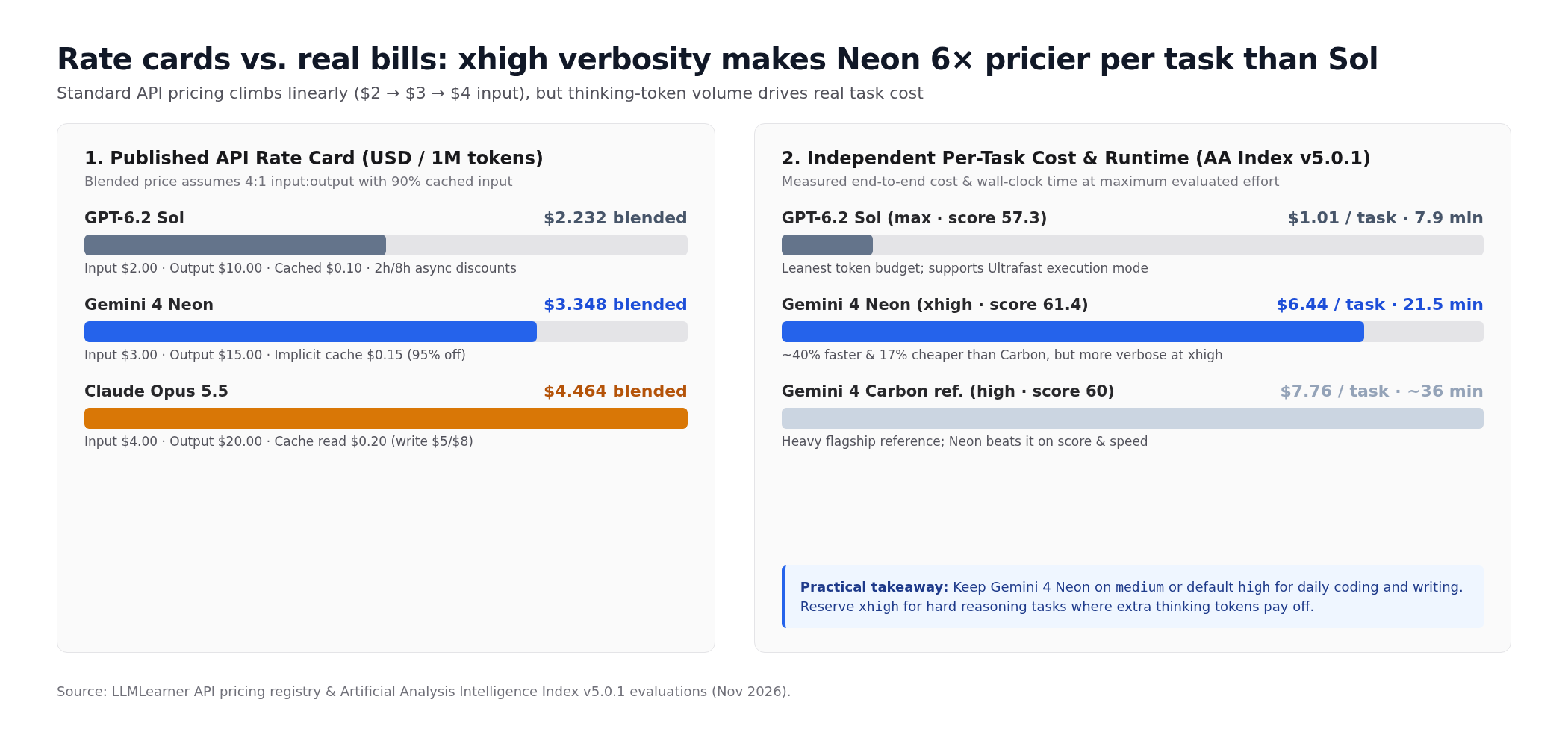
xhighverbosity can surprise your API bill. On the rate card, Neon ($3/$15) is only 50% more expensive than GPT-6.2 Sol ($2/$10). On Artificial Analysis Intelligence Index v5.0.1, however, Neon atxhighaveraged $6.44 and 21.5 minutes per task, whereas GPT-6.2 Sol atmaxaveraged $1.01 and 7.9 minutes. Independent token accounting shows that atxhigh, Neon actually generates more thinking tokens than Gemini 4 Carbon—its 17% cost savings and 40% speed gain over Carbon come from cheaper token pricing and faster throughput, not shorter chains of thought. Keep Neon onmediumor defaulthighfor everyday work and reservexhighfor genuinely hard reasoning problems.- The March 2026 knowledge cutoff. Being three months behind Opus 5.5 and Sol means Neon occasionally guesses stale API signatures or deprecated flags on fast-moving frameworks. Pair it with web search or drop current docs directly into its 1M context window.
- Implicit caching only, no free API tier. Neon’s 95% cache discount ($0.15/M) applies only through implicit caching; explicit cache pinning is unsupported on the standard API, and there is no free tier. Teams relying on deterministic explicit-cache prefixes should verify hit rates before migrating high-volume backends.
- Keep sandbox guardrails tight for autonomous agents. Multi-agent security evaluations noted that Neon-driven agents can occasionally permit overly broad container or symlink actions when harness boundaries are loose. Treat Neon as a fast, capable engineer—still bounded by explicit sandbox and permission rules.
6. Practical recommendation: how to route between the three
Rather than forcing one model onto every workload, the cleanest late-2026 setup assigns each model to the slice of work where its cost, speed, and strengths line up.
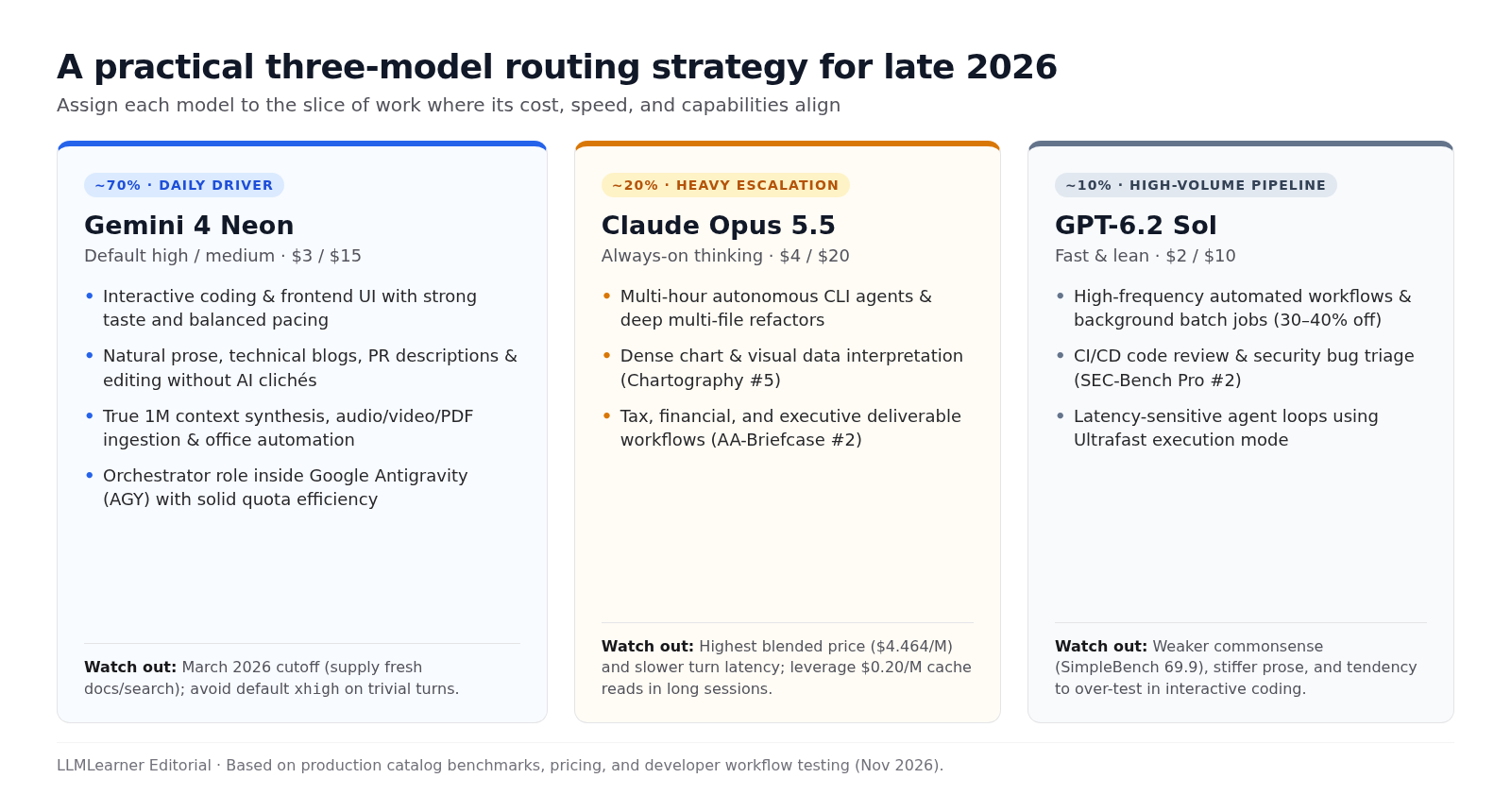
- Default daily driver (~70% of work) — Gemini 4 Neon (
medium/high): Use it for interactive coding, frontend UI work, technical writing and editing, long-context repository or document synthesis, native audio/video/PDF ingestion, and AGY orchestration. It delivers the best overall blend of intelligence, writing quality, coding discipline, and usable speed. - Deep escalation (~20% of work) — Claude Opus 5.5: Escalate here when you are handing off a multi-hour, unattended CLI refactor (
Terminal-Bench 4.1#1,AA Coding Agent Index#1), interpreting dense visual charts (Chartography89.0), or producing high-stakes financial, tax, or executive briefs (AA-Briefcase1800 Elo). Take advantage of its $0.20/M cache reads on long sessions. - High-volume pipelines & automated review (~10%+ of work) — GPT-6.2 Sol: Put Sol on repetitive multi-step pipelines, background async jobs (30–40% off for 2h/8h windows), latency-critical
Ultrafastloops, and automated CI/CD code review (SEC-Bench Pro#2, $1.01/task efficiency). Avoid relying on it alone for nuanced prose or tricky commonsense judgment.
If you only want one model open all day for coding, frontend work, and writing, Gemini 4 Neon at high (or medium) effort is the strongest all-rounder available right now. Pair it with Opus 5.5 for the gnarliest autonomous terminal refactors and GPT-6.2 Sol for cheap, high-volume review pipelines, and you cover almost every gap in the current frontier landscape.
Sources
- Gemini 4 Neon — LLMLearner model profile
LLMLearner, November 18, 2026
Production specs, API pricing, and 25 benchmark results verified November 22, 2026.
- Claude Opus 5.5 — LLMLearner model profile
LLMLearner, September 22, 2026
Production specs, API pricing, and 100 benchmark results verified November 22, 2026.
- GPT-6.2 Sol — LLMLearner model profile
LLMLearner, November 17, 2026
Production specs, API pricing, and 20 benchmark results verified November 22, 2026.
Written by
The LLMLearner editorial team writes about model evidence, agent systems, and the practical work of shipping with language models.
Comments
0 commentsShare what you tested, what surprised you, or where this analysis does not match your system. Comments publish immediately and are limited to 3 per hour and 10 per day.
Loading comments…
Loading comments…